Free Australian Citizenship Practice Test
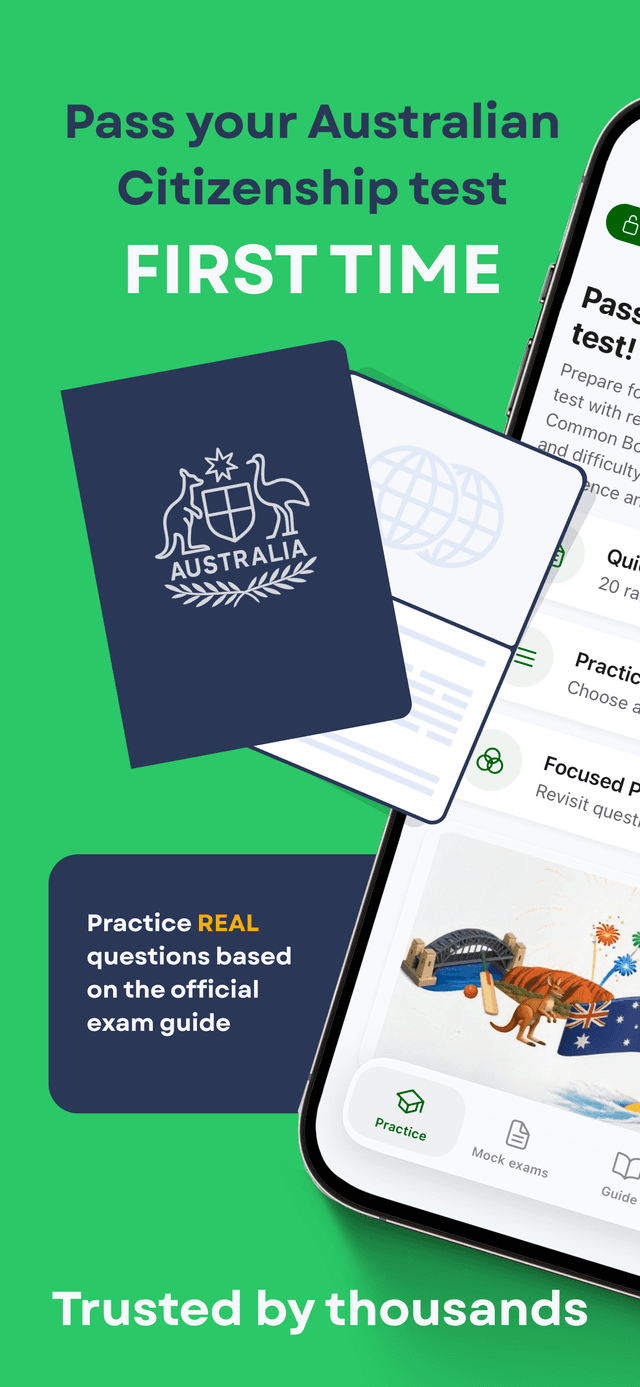
20 real questions covering all 4 sections of the Australian citizenship test, with instant results and detailed explanations. 75% to pass — takes about 5 minutes.
What is the Australian Citizenship Test?
The citizenship test is a computer-based multiple-choice exam run by the Department of Home Affairs. You have 45 minutes to answer 20 questions drawn from the official resource, Australian Citizenship: Our Common Bond. A passing score is 15 out of 20 (75%), and you must also answer all 5 Australian values questions correctly.
The test covers four sections: Australia and its people, Australia's democratic beliefs, government and the law, and Australian values. The practice test above covers all four sections so you can see where to focus your study.
Australia's top-rated citizenship test app
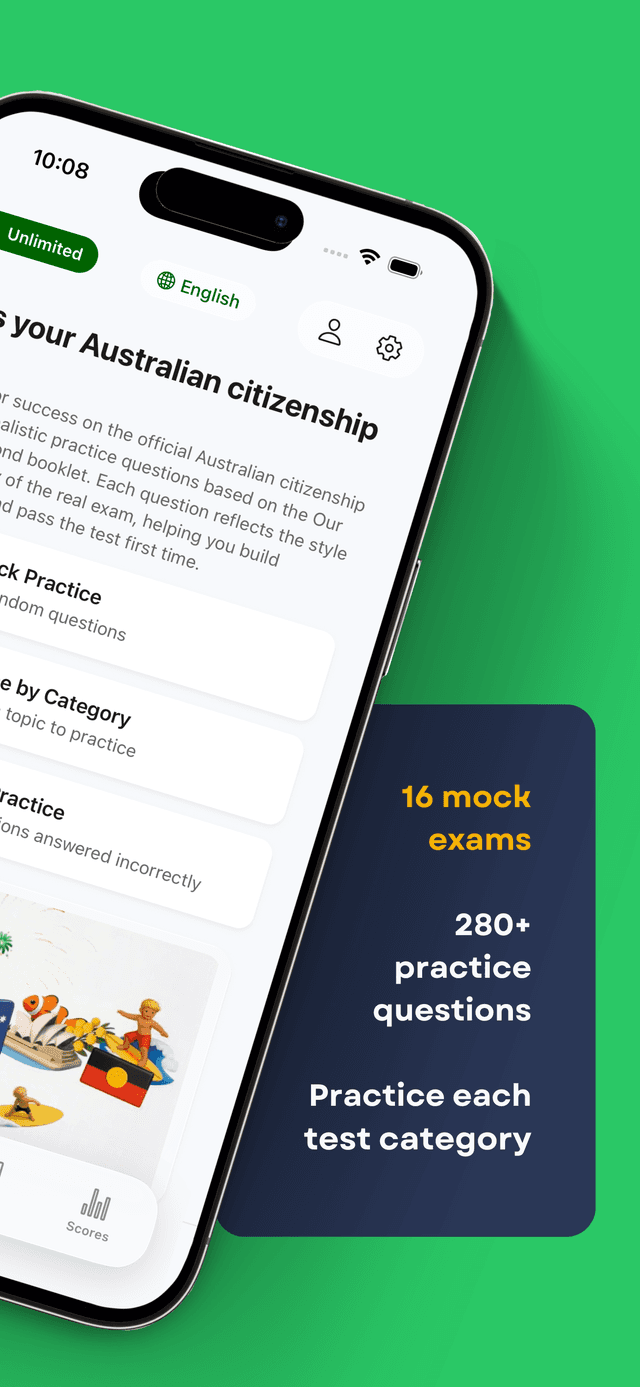
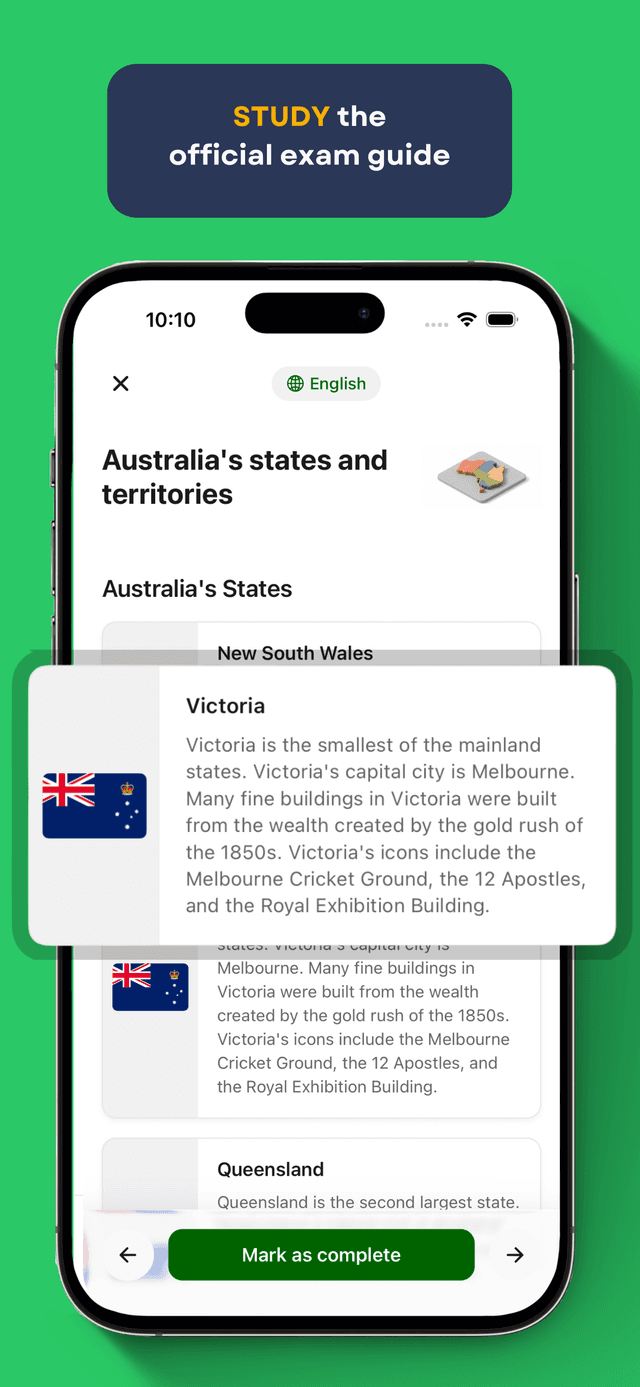
Keep practising with 280+ questions, 16 timed mock exams, and the complete study guide in 13 languages. Free to download on iOS and Android.
280+ Practice Questions
Every question from the official test bank, covering people, government, beliefs, and values.
16 Timed Mock Exams
Full-length practice exams scored exactly like the real test. 45-minute timer, 75% pass mark.
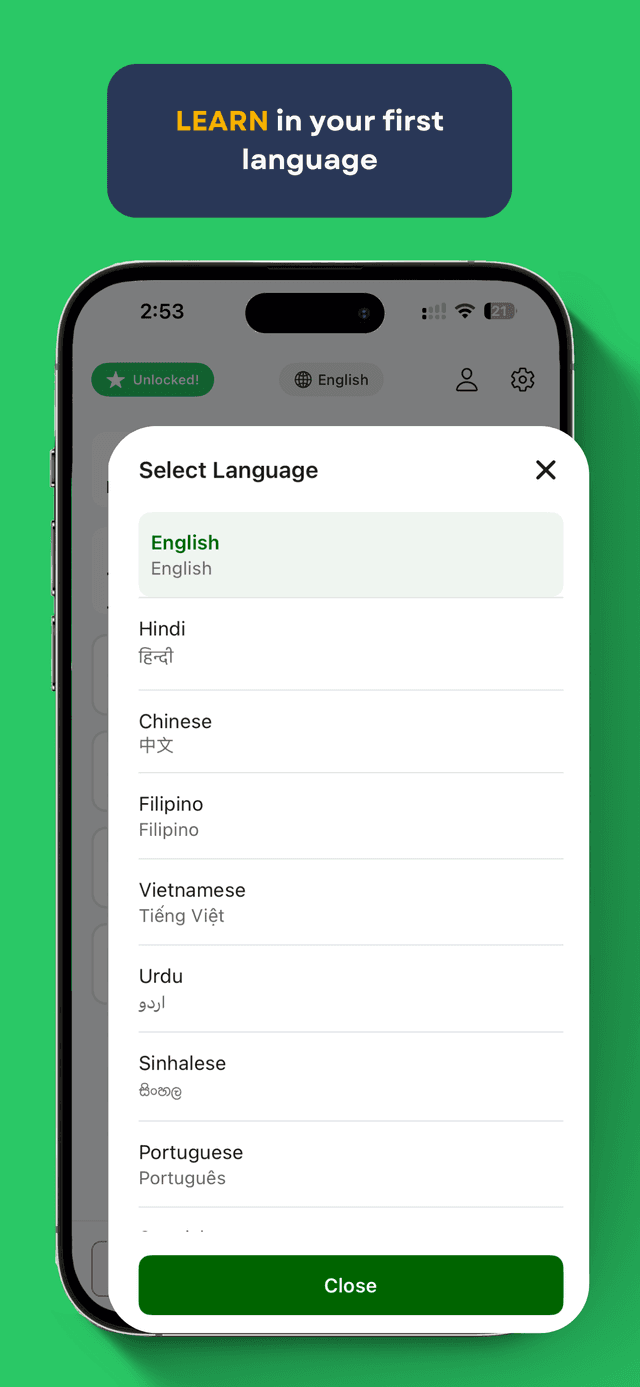
13 Languages
Study in your first language. Questions, options, and explanations in Hindi, Chinese, Filipino, and 10 more.
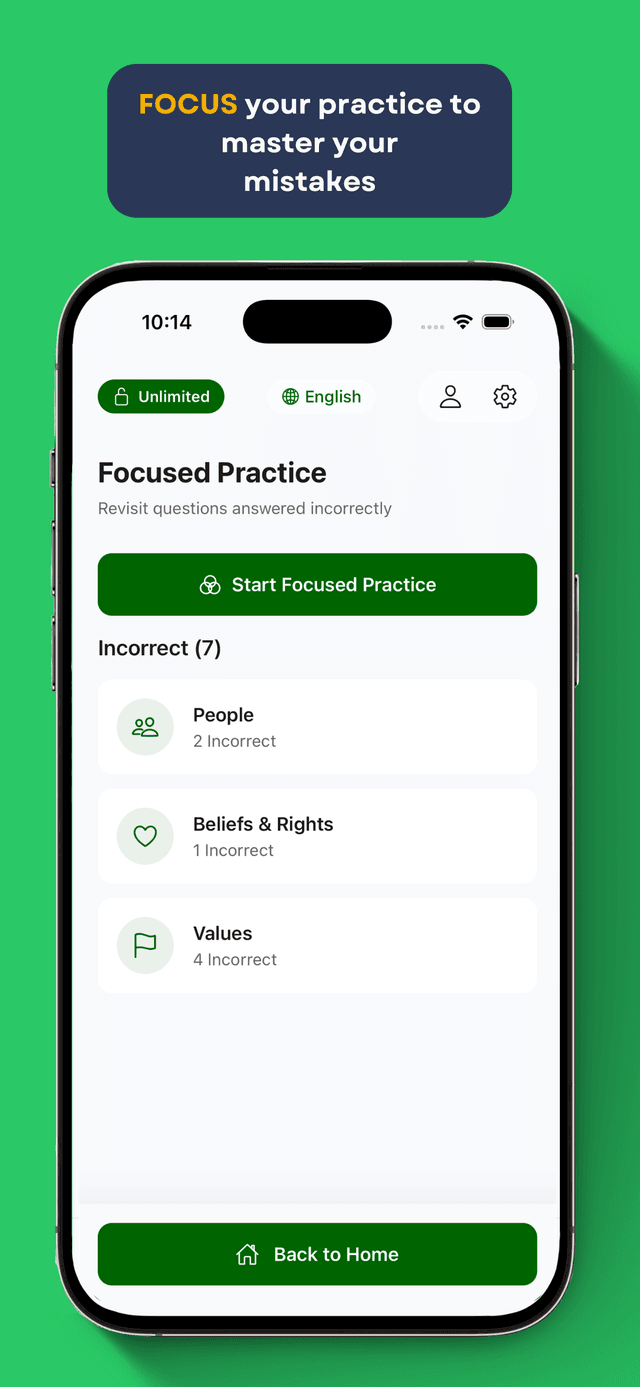
Focused Practice
Learn from your mistakes. The app tracks every wrong answer so you can practise the questions you struggle with.
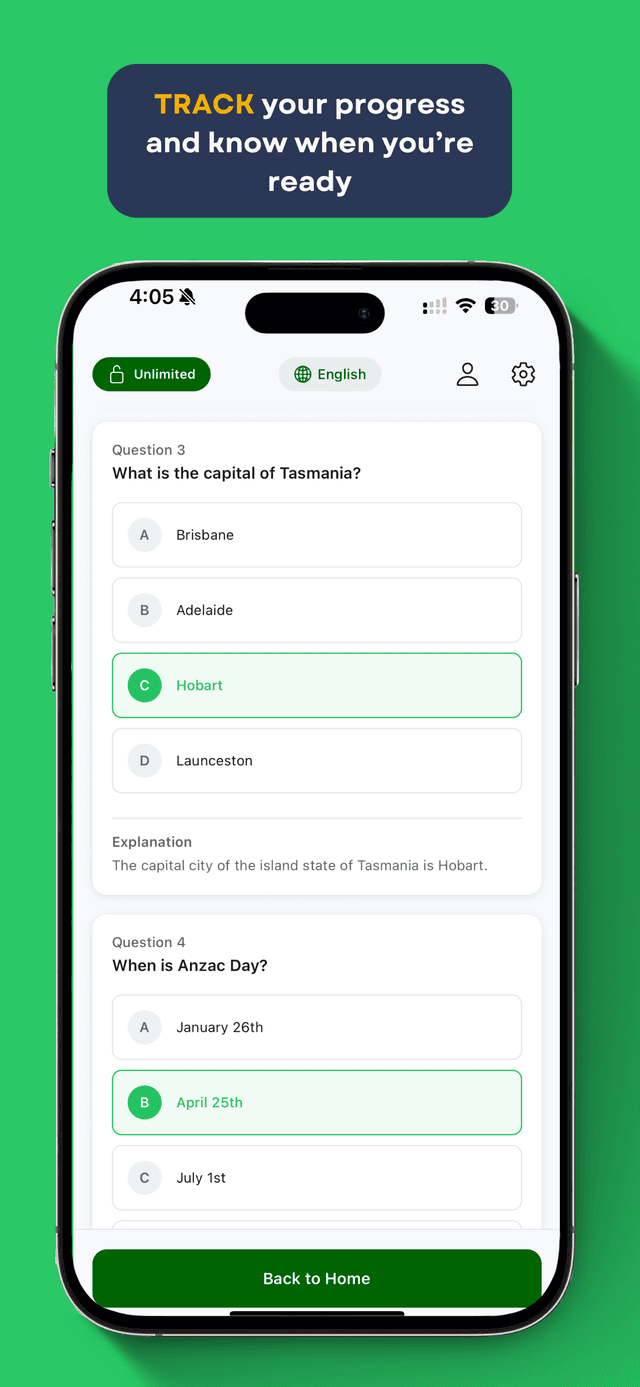
Progress Tracking
See your scores, track improvement over time, and know when you are ready for the real test.
Detailed Explanations
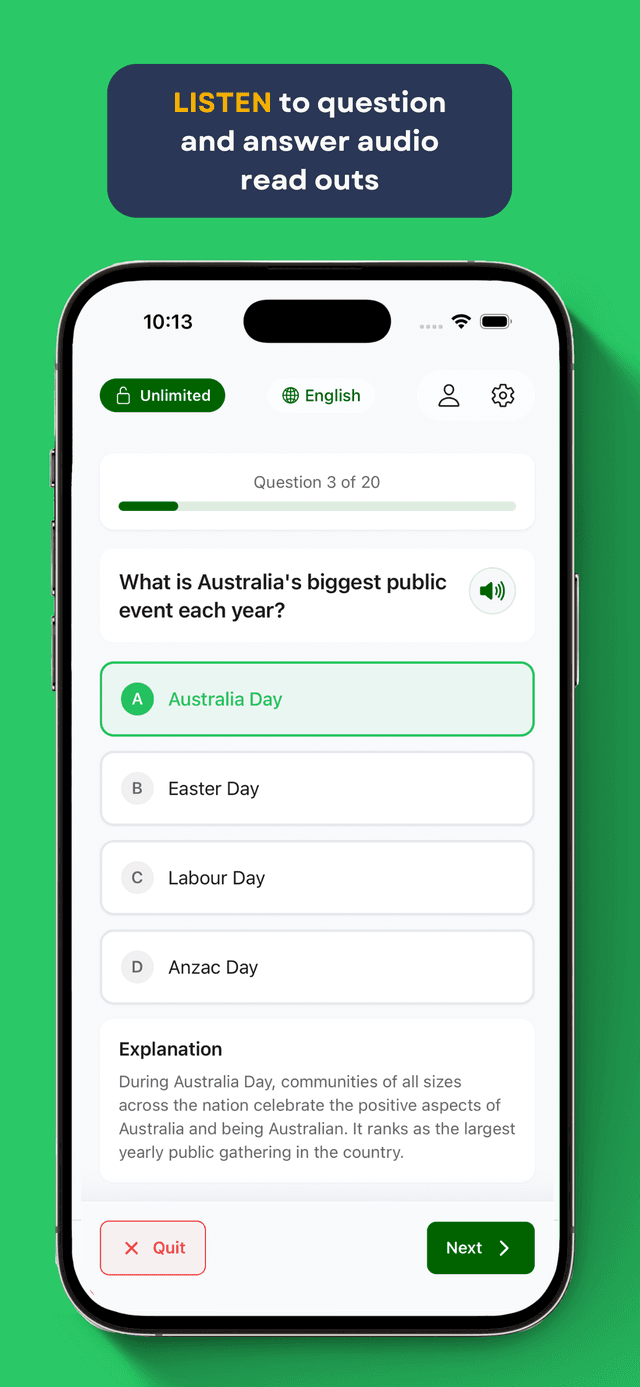
Every question includes a clear explanation so you understand the answer, not just memorise it.
See the app in action
Clean, simple design that makes studying easy.
Loved by future Australians
Rated 4.7 stars on the App Store by 355 reviewers
“Passed my Exam! The app helped a lot, the questions were similar the real exam.”
W. Becker
“Helped me to pass. Simple app that does the job and is easy to use. Passed first time!”
A. Hughs
“Best app to prepare for the test with excellent questions and accurate answers.”
A. Amilthan
“I tried three different apps but this one was the best and helped me to pass.”
P. Koutlakis
Australian Citizenship Test Questions and Answers
Review all 20 practice questions below with correct answers and explanations.
1. Who were Australia's first inhabitants?
Explanation
The Aboriginal and Torres Strait Islander peoples were the original inhabitants of Australia. They constitute the Indigenous populations of the country.
2. What percentage of Australians were born overseas?
Explanation
Immigrants to Australia play a vital role and make significant contributions to the nation. Over a quarter of the population was born overseas.
3. What is the capital of the Australian Capital Territory?
Explanation
Canberra is the capital of the ACT and also functions as the national capital of Australia.
4. Which of the following are Australia's national colours?
Explanation
Australia's official national colours are green and gold, inspired by the golden wattle. National sports teams typically wear uniforms in these colours.
5. Where is the Great Barrier Reef?
Explanation
The internationally renowned Great Barrier Reef is situated along the eastern coastline of Queensland. Brisbane is the capital city of Queensland.
6. Australians believe in all of the following EXCEPT:
Explanation
Australia's democratic values form the foundation of its society and culture, attracting many individuals to seek citizenship.
7. The service in the Australian Defence Force is:
Explanation
Enlistment in the Australian Defence Force is optional.
8. As Australian citizens, we vote for:
Explanation
Citizens cast votes to select the individuals they wish to act as their representatives in parliament.
9. Gender equality in Australia means that:
Explanation
Men and women have equal rights in Australia. It is against the law to discriminate against a person because of their gender.
10. How can citizens participate actively in Australian society?
Explanation
Active participation includes joining community groups, volunteering, and engaging in political life, alongside responsibilities like voting and paying taxes.
Want more practice questions?
Get 280+ questions, 16 mock exams & a complete study guide in 13 languages.
11. Prior to 1901, how many self-governing British colonies existed in Australia?
Explanation
Before Federation in 1901, the landmass we now know as Australia consisted of six distinct, self-ruling British colonies.
12. What term describes the political party or coalition holding the second-highest number of seats in the House of Representatives?
Explanation
The entity known as the Opposition consists of the party or coalition that has secured the second-largest number of members in the House of Representatives, led by the Leader of the Opposition.
13. Which term is synonymous with the Australian Government?
Explanation
The national government of Australia is often referred to using alternative names like the Federal Government or the Commonwealth Government.
14. Which of the following statements comparing state and federal governments is FALSE?
Explanation
The operational structures of state governments largely mirror that of the Australian Government, including having parliamentary systems and a Governor representing the Head of State.
15. Which body has the power to make laws for Australia?
Explanation
The power to make and change federal laws rests with the Australian Parliament, which consists of the King (represented by the Governor-General), the Senate, and the House of Representatives.
16. How is Australia's governmental structure best described?
Explanation
Australia employs a system of parliamentary democracy, signifying that its citizens participate in the governance of the nation.
17. What serves as Australia's official national language?
Explanation
English holds the status of Australia’s national language and constitutes an element of the nation's identity.
18. Which of these practices is explicitly mentioned as being against the law in Australia due to conflicting with Australian values and laws?
Explanation
Some religious or cultural practices, such as polygamy (being married to more than one person at the same time) and forced marriage, are against the law in Australia and can result in severe legal penalties, including imprisonment.
19. Why is learning English considered important in Australian society?
Explanation
It is important to learn to speak English because it helps to get an education, a job, and better integrate into the community. It is essential for economic participation and social cohesion.
20. What does "mutual respect" entail in Australian society?
Explanation
In Australia, individuals must respect the freedom and dignity of others, and their opinions and choices. People should be tolerant of each other where they find that they disagree.
Need to study first? Read our free study guide covering all 4 test sections. Prefer paper? Download our 50 free printable practice questions and answers.
Ready for the real test?
Get access to 280+ practice questions, 16 full mock exams, and a complete study guide in 13 languages.