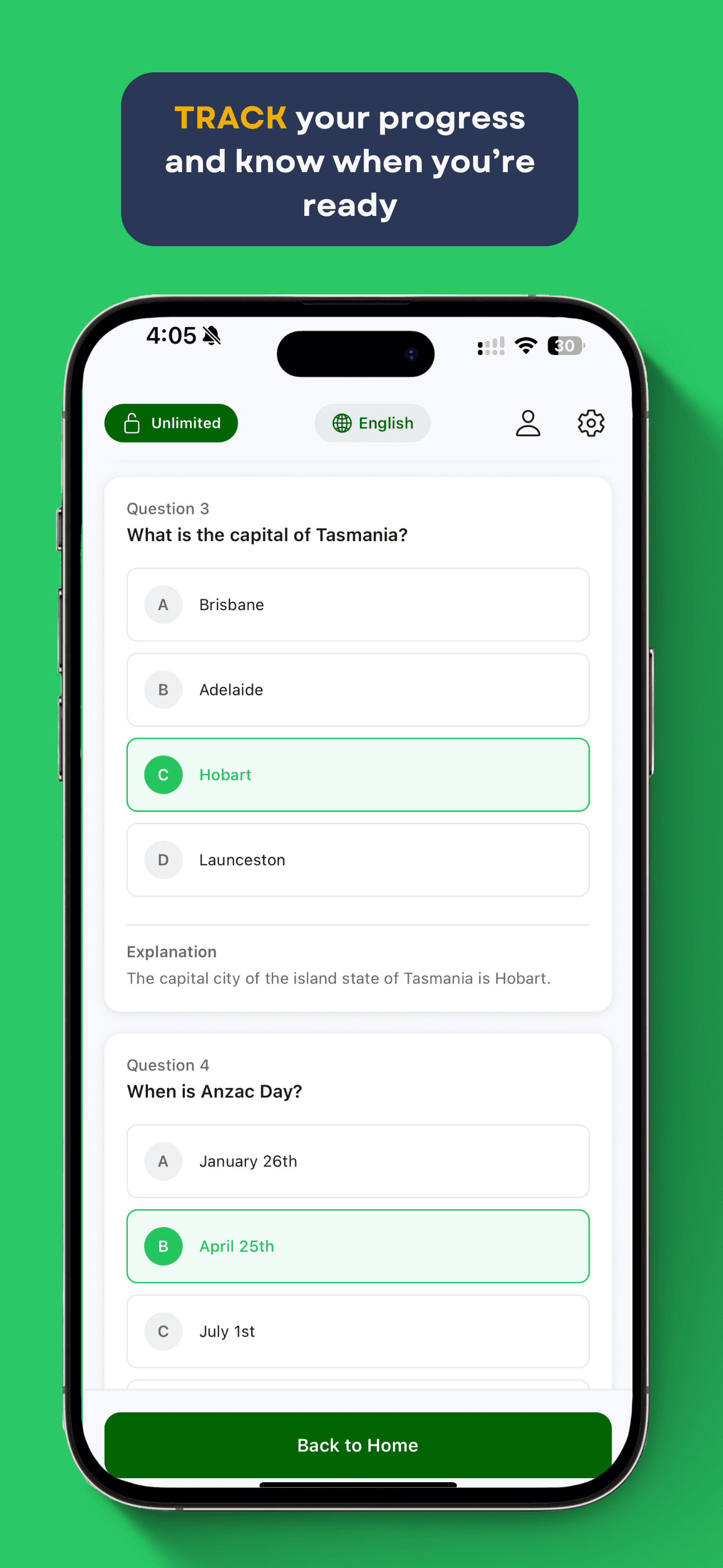
These are practice questions, not questions from the real test. The PDF has a separate answer key with explanations. Prefer not to download? Read every question and answer below, or try the free online Australian citizenship practice test without an account. You can still print this page from your browser.
Know the real test format first
The real test has 20 computer-based multiple-choice questions. You have 45 minutes. To pass, you must:
- answer at least 15 of the 20 questions correctly
- answer all 5 Australian values questions correctly
All questions come from the testable section of the Department of Home Affairs booklet, Australian Citizenship: Our Common Bond. The official booklet is the source you should trust if another resource disagrees with it.
This 50-question set is a study bank, not a mock exam. It contains extra questions so you can find weak topics before taking a timed 20-question test.
Part 1: Australia and its people
1. Who were Australia’s first inhabitants?
- AThe people of the First Fleet
- BAboriginal and Torres Strait Islander peoples
- CPeople from New Zealand
- DBritish soldiers
Answer: B. Aboriginal and Torres Strait Islander peoples
Aboriginal and Torres Strait Islander peoples have the oldest continuous cultures and traditions in the world. Aboriginal peoples are historically from mainland Australia and Tasmania. Torres Strait Islander peoples are from the islands between Queensland and Papua New Guinea.
2. What was the First Fleet?
- AThe first Australian navy
- BThe first group of gold miners
- CThe 11 convict ships that arrived from Great Britain in 1788
- DThe ships that brought the first federal parliament to Canberra
Answer: C. The 11 convict ships that arrived from Great Britain in 1788
The First Fleet arrived from Great Britain on 26 January 1788. This marked the start of European settlement in New South Wales.
3. What happened in Australia in 1901?
- ACanberra became the capital
- BThe colonies united in a federation
- CThe gold rush began
- DThe First Fleet arrived
Answer: B. The colonies united in a federation
The separate colonies united to form the Commonwealth of Australia in 1901. Australia’s national democratic institutions were established under the Australian Constitution.
4. What is the capital city of Australia?
- ASydney
- BMelbourne
- CCanberra
- DBrisbane
Answer: C. Canberra
Canberra is Australia’s national capital. Sydney is the capital of New South Wales, and Melbourne is the capital of Victoria.
5. How many states and mainland territories does Australia have?
- ASix states and two mainland territories
- BSeven states and one territory
- CEight states and two territories
- DSix states and six territories
Answer: A. Six states and two mainland territories
The six states are New South Wales, Victoria, Queensland, Western Australia, South Australia and Tasmania. The two mainland territories are the Australian Capital Territory and the Northern Territory.
6. What is the capital of New South Wales?
- ANewcastle
- BCanberra
- CSydney
- DWollongong
Answer: C. Sydney
Sydney is the capital of New South Wales. Canberra is in the Australian Capital Territory.
7. What is Australia’s national flower?
- AThe rose
- BThe golden wattle
- CThe waratah
- DThe lotus
Answer: B. The golden wattle
The golden wattle is Australia’s national flower. Its colours are linked with Australia’s national colours.
8. What are Australia’s national colours?
- ARed and blue
- BBlack and gold
- CGreen and gold
- DBlue and white
Answer: C. Green and gold
Green and gold are the colours of the golden wattle. Australian national sports teams often wear them.
9. When is Anzac Day commemorated?
- A1 January
- B25 April
- C26 January
- D11 November
Answer: B. 25 April
Anzac Day is named after the Australian and New Zealand Army Corps. It remembers Australians who served and died in wars, conflicts and peacekeeping operations.
10. Who can give an Acknowledgement of Country?
- AOnly an elected official
- BOnly an Aboriginal Elder
- CAnyone
- DOnly the event organiser
Answer: C. Anyone
Anyone can give an Acknowledgement of Country. A Welcome to Country is different. It is performed by an Aboriginal or Torres Strait Islander custodian of the local region.
Part 2: Australia’s democratic beliefs, rights and liberties
11. What type of democracy does Australia have?
- ADirect democracy
- BParliamentary democracy
- CMilitary democracy
- DReligious democracy
Answer: B. Parliamentary democracy
Australian citizens vote for representatives to parliament. Those representatives answer to the people through elections.
12. What does the Rule of Law mean?
- AOnly judges must obey the law
- BParliament can ignore the law
- CEveryone is subject to the law
- DReligious rules are above Australian law
Answer: C. Everyone is subject to the law
No person, group or religious rule is above Australian law. This includes government and community leaders, police and people in business.
13. Which statement about freedom of speech is correct?
- APeople may express opinions while obeying Australian law
- BPeople may break the law when protesting
- COnly citizens may express political opinions
- DThe government must approve every public opinion
Answer: A. People may express opinions while obeying Australian law
People in Australia can criticise the government and protest peacefully. They must still obey the law and respect the rights of others.
14. Does Australia have an official national religion?
- AYes, Christianity
- BYes, the religion chosen by parliament
- CNo
- DEach state chooses one
Answer: C. No
Australia has no official national religion. The government is secular, which means it operates separately from churches and other religious bodies.
15. What does freedom of association mean?
- APeople must join a political party
- BPeople may join or leave any lawful organisation
- COnly citizens may join community groups
- DEmployers choose which groups workers may join
Answer: B. People may join or leave any lawful organisation
People can join lawful political parties, trade unions, religious groups, cultural groups or social clubs. They may also choose not to join.
16. Which statement reflects equality in Australia?
- AMen have more legal rights than women
- BWomen have more legal rights than men
- CMen and women have equal rights
- DRights depend on a person’s religion
Answer: C. Men and women have equal rights
Australian law supports equal rights and opportunities. It is against the law to discriminate against a person because of their gender.
17. What voting responsibility do Australian citizens aged 18 or over have?
- AThey must vote only in local elections
- BThey must vote in federal and state or territory elections, and referendums
- CVoting is always optional
- DThey must vote only when a new prime minister is chosen
Answer: B. They must vote in federal and state or territory elections, and referendums
Voting is a responsibility, right and privilege of citizenship. Rules for local government elections vary between states and territories.
18. What should an Australian citizen do if called for jury service?
- AIgnore the notice
- BServe on the jury unless lawfully excused
- CSend a family member instead
- DPay someone to take their place
Answer: B. Serve on the jury unless lawfully excused
Serving on a jury when called is a responsibility of Australian citizens aged 18 or over. Juries help keep the court system open and fair.
19. Which is a privilege of Australian citizenship?
- AIgnoring Australian law
- BApplying for an Australian passport
- CAvoiding elections
- DReceiving automatic government employment
Answer: B. Applying for an Australian passport
Australian citizens can apply for an Australian passport and re-enter Australia freely. Citizenship does not guarantee a government job.
20. Is service in the Australian Defence Force compulsory?
- AYes, for every citizen
- BYes, for every person aged 18
- CNo, service is voluntary
- DNo, because citizens have no duty to defend Australia
Answer: C. No, service is voluntary
Service in the Australian Defence Force is voluntary. Australian citizens still have a responsibility to defend Australia should the need arise.
Ready to try a timed mock exam?
Practise online or in the app with instant scoring and progress tracking.
Free to start. Unlimited practice requires a subscription.
Part 3: Government and the law in Australia
21. What is the Australian Constitution?
- AA list of local council rules
- BThe legal document that sets out the basic rules for Australia’s government
- CA speech given on Australia Day
- DThe rules of one political party
Answer: B. The legal document that sets out the basic rules for Australia’s government
The Constitution established the Commonwealth of Australia. It sets out how the Australian Government works and how powers are shared.
22. Who is Australia’s Head of State?
- AThe Prime Minister
- BThe King of Australia
- CThe Chief Justice
- DThe Governor of New South Wales
Answer: B. The King of Australia
Australia is a constitutional monarchy. The King of Australia is the Head of State, but does not have a day-to-day role in government.
23. Who represents the Head of State in Australia?
- AThe Prime Minister
- BThe Governor-General
- CThe Speaker of the House
- DThe Chief Minister
Answer: B. The Governor-General
The King appoints the Governor-General as his representative in Australia on the advice of the Prime Minister.
24. What are the two Houses of the Australian Parliament?
- AThe House of Commons and the Senate
- BThe House of Representatives and the Senate
- CThe Legislative Council and the High Court
- DThe Cabinet and the House of Review
Answer: B. The House of Representatives and the Senate
Both Houses consider, debate and vote on proposed laws. A proposed law is called a bill.
25. What is another name for the House of Representatives?
- AThe Upper House
- BThe States’ House
- CThe Lower House or People’s House
- DThe High Court
Answer: C. The Lower House or People’s House
Members of Parliament in the House of Representatives represent people in federal electorates.
26. How many senators does each Australian state elect?
- ATwo
- BSix
- CTen
- DTwelve
Answer: D. Twelve
Each state elects 12 senators. The Australian Capital Territory and the Northern Territory each elect two senators.
27. How is the Australian Government generally formed after a federal election?
- AThe King selects any political party
- BThe party or coalition with the majority in the House of Representatives forms government
- CThe High Court chooses the government
- DLocal councils vote for the government
Answer: B. The party or coalition with the majority in the House of Representatives forms government
Its leader becomes the Prime Minister. The party or coalition with the second largest number of members usually forms the Opposition.
28. What is the role of the Prime Minister?
- ALeader of the Australian Government
- BHead of the High Court
- CRepresentative of every local council
- DHead of State
Answer: A. Leader of the Australian Government
The Prime Minister leads the Australian Government. The Prime Minister is not Australia’s Head of State.
29. Which service is mainly an Australian Government responsibility?
- ARubbish collection
- BImmigration and citizenship
- CLocal libraries
- DStreet signs
Answer: B. Immigration and citizenship
The Australian Government is also responsible for areas such as defence, foreign affairs, taxation, social security and postal services.
30. Which service is mainly a state or territory government responsibility?
- AForeign affairs
- BDefence
- CSchools
- DPassports
Answer: C. Schools
State and territory governments are mainly responsible for schools, hospitals, police, ambulance services, roads and public transport.
Know which topics need more practice.
Practise online or in the app with instant scoring and progress tracking.
Free to start. Unlimited practice requires a subscription.
31. Which service is mainly a local government responsibility?
- AImmigration
- BDefence
- CRubbish collection
- DIncome tax
Answer: C. Rubbish collection
Local councils also manage many local roads, parks, libraries, building permits and community facilities.
32. Why are courts and judges independent of parliament and government?
- ASo they can interpret and apply the law without political control
- BSo they can make election promises
- CSo they can collect taxes
- DSo they can appoint the Prime Minister
Answer: A. So they can interpret and apply the law without political control
Judicial independence supports fair decisions. Courts decide whether a person has broken the law and apply legal penalties.
33. What is Australia’s highest court?
- AThe Federal Circuit and Family Court
- BThe High Court of Australia
- CThe Senate
- DThe Supreme Court of New South Wales
Answer: B. The High Court of Australia
The High Court has the final say on how Australian law is interpreted. It also interprets the Constitution.
34. What is a referendum?
- AA vote to change the Australian Constitution
- BA vote to choose a local mayor only
- CA meeting of judges
- DA survey run by a political party
Answer: A. A vote to change the Australian Constitution
Australian citizens vote on a proposed constitutional change. A proposal must meet the required double majority to pass.
35. Who may vote in a federal election or referendum?
- AAny visitor to Australia
- BAustralian citizens aged 18 or over who are enrolled to vote
- CPermanent residents of any age
- DOnly people who own property
Answer: B. Australian citizens aged 18 or over who are enrolled to vote
Eligible Australian citizens must enrol with the Australian Electoral Commission. Voting is compulsory once enrolled.
Part 4: Australian values
Remember: The real test includes exactly five Australian values questions. You must answer all five correctly. Give this section extra attention.
36. Which action respects the freedom and dignity of the individual?
- ATreating people as inferior because of their background
- BAllowing people to make lawful choices about their lives
- CUsing threats to control another person
- DDenying equal treatment to people with different beliefs
Answer: B. Allowing people to make lawful choices about their lives
Australian values include respect for each person’s freedom and dignity. Everyone must also obey Australian law.
37. Is violence an acceptable way to change a person’s opinion?
- AYes, if the issue is important
- BYes, inside a family
- CNo
- DOnly during a political disagreement
Answer: C. No
Australia values peaceful discussion and democratic processes. Violence and intimidation are not accepted ways to settle disagreements.
38. What should you do when police make a lawful request?
- AObey it
- BIgnore it
- CObey it only if you agree with it
- DAsk another person to decide
Answer: A. Obey it
Police are subject to the law, and people in Australia should support lawful police action. The key word is lawful.
39. What does a “fair go” mean?
- AEveryone must receive the same result
- BPeople should have equal opportunity based on their skills and effort
- CFamily connections should decide who gets a job
- DThe law should favour wealthy people
Answer: B. People should have equal opportunity based on their skills and effort
A fair go means equal opportunity. It does not mean that every person will have the same outcome.
40. What do new citizens promise in the Australian Citizenship Pledge?
- ALoyalty to one political party
- BLoyalty to Australia and its people
- CAgreement with every government decision
- DMembership of a religion
Answer: B. Loyalty to Australia and its people
The pledge also refers to sharing Australia’s democratic beliefs, respecting its rights and liberties, and upholding and obeying its laws.
Keep your results for your next study session.
Practise online or in the app with instant scoring and progress tracking.
Free to start. Unlimited practice requires a subscription.
41. What is Australia’s national language?
- AEnglish
- BAustralia has no national language
- CLatin
- DEach state has a different national language
Answer: A. English
Australian society values English as the national language and as a unifying part of society. Other languages are also valued.
42. Which action shows compassion for those in need?
- AIgnoring a neighbour who needs practical help
- BVolunteering in the community
- CRefusing to help anyone outside your family
- DUsing threats to make people cooperate
Answer: B. Volunteering in the community
Helping people in need is part of the Australian idea of mateship. Community service and volunteering can strengthen the community.
43. What does loyalty to Australia require from a citizen?
- APutting another country’s interests ahead of Australia’s
- BNot undermining Australia’s interests and security
- CAgreeing with every politician
- DGiving up every other citizenship
Answer: B. Not undermining Australia’s interests and security
Citizens pledge loyalty to Australia and its people. Peaceful criticism of government is allowed and is part of freedom of speech.
44. What happens when a religious practice conflicts with Australian law?
- AThe religious practice always wins
- BAustralian law prevails
- CThe person may choose which rule to follow
- DThe local council decides privately
Answer: B. Australian law prevails
People may follow any religion or no religion. Everyone must obey Australian law.
45. Is forced marriage legal in Australia?
- AYes, if parents approve
- BYes, for people over 18
- CNo
- DOnly if it happens outside Australia
Answer: C. No
People are free to choose whether to marry and whom to marry. Forcing someone to marry is against Australian law.
46. Is violence against a spouse or partner accepted in Australia?
- AYes, if it happens at home
- BNo
- CYes, if no one reports it
- DIt depends on the family’s traditions
Answer: B. No
Domestic and family violence is against Australian law. Culture or tradition does not excuse violence.
47. Which statement about racism reflects Australian values?
- ARacism is acceptable in private groups
- BRacism has no place in Australia
- CRacial abuse is allowed online
- DThe law protects only some backgrounds
Answer: B. Racism has no place in Australia
Australian values include mutual respect and equality. Racial abuse and discrimination can also break Australian law.
48. How should people respond to a political disagreement?
- AUse violence
- BThreaten the other person
- CDiscuss it peacefully and use democratic processes
- DDamage public property
Answer: C. Discuss it peacefully and use democratic processes
Australia supports peaceful persuasion, lawful protest and democratic change. Violence is rejected.
49. What should a person do if they suspect someone is planning a serious crime?
- AIgnore it
- BReport it to Australian government authorities
- CShare it on social media only
- DConfront the person with violence
Answer: B. Report it to Australian government authorities
People share responsibility for keeping the community safe. A serious concern should go to the proper authorities.
50. Can an Australian citizen hold citizenship of another country?
- ANever
- BYes, if the other country’s law also allows it
- COnly for one year
- DOnly with approval from a local council
Answer: B. Yes, if the other country’s law also allows it
Australia permits dual or multiple citizenship. An Australian citizen in Australia must follow Australian law, even if they also hold another citizenship.
How to use these 50 questions
- Answer each question without looking at the answer.
- Mark every wrong or uncertain answer.
- Return to the matching part of the free study guide.
- Repeat only your weak questions the next day.
- Build a 20-question practice set with 5 values questions and 15 questions from the other sections.
- Stop the timer at 45 minutes, even though most people will finish sooner.
Do not judge readiness from one good score. Aim to pass several mixed practice tests in a row and get every values question right each time.
Keep studying with our practice tests by topic, or explore the citizenship test app.
Frequently asked questions
Are these the real Australian citizenship test questions?
No. The Department of Home Affairs does not publish the live test bank. These are original practice questions based on the official testable material. The official practice test also says its questions are samples and will be different on test day.
Can I take a PDF into the real test?
No. Home Affairs does not allow books, notes, mobile phones or other study materials in the testing area. Use this set before your appointment.
Is the real test available as a PDF?
No. The real citizenship test is completed on a computer or tablet at an approved test location. A printable PDF is useful for study, but it does not copy the test-day format.
What should I read before using practice questions?
Read the testable section of Our Common Bond. Home Affairs says all test questions are based on that booklet. It covers Australia and its people, democratic beliefs and liberties, government and law, and Australian values.
Can I study Our Common Bond in another language?
Yes. Home Affairs publishes the booklet in English and many community languages. The real test is conducted in English.
Where can I take a scored practice test?
Use the free 20-question Australian citizenship practice test on this site. You can also use the official Home Affairs practice test. Start with the free practice test or the official Home Affairs practice test.
About this article
David Okafor writes test-preparation strategy for Pass Australian Citizenship, focused on practice technique and pacing.
Reviewed by Andy Downing, who sat and passed the Australian citizenship test and runs Pass Australian Citizenship.
Official sources
- Department of Home Affairs, Prepare for the citizenship test
- Department of Home Affairs, Learn about the citizenship test
- Department of Home Affairs, Australian Citizenship: Our Common Bond
- Department of Home Affairs, official Australian citizenship practice test
Last checked: 21 August 2026